The intended pricing of OpenAI's Chat GPT ads has become the hottest debate in media circles in the past week. After announcing trials of ads within the free tiers of ChatGPT, OpenAI has caused controversy, not just by implementing ads in the first place, but allegedly by setting an asking price many times higher than other digital media ad spots.
With a base price of reportedly $60 per thousand impressions, the new ads blow the prices of other digital ads out of the water. Commentators have pointed to the average price of display ads being between $11 and $17 per thousand impressions (or CPM, to use the industry terminology). Rates of $3 CPM for display are not unheard of.
Until now, the ad units with the highest base rates were video ads. Adwave reports that the CPMs for Netflix (in regions where they run ads on some tiers) effectively cost $37 CPM.
Now it's worth pointing out there can be a big difference between the asking price of ads, or the rate card, and the actual price that ends up being paid. But it appears OpenAI really wants to aim for that premium pricing.
This gamble that some brands will be prepared to pay well over the odds has been met with confusion if not outright derision.
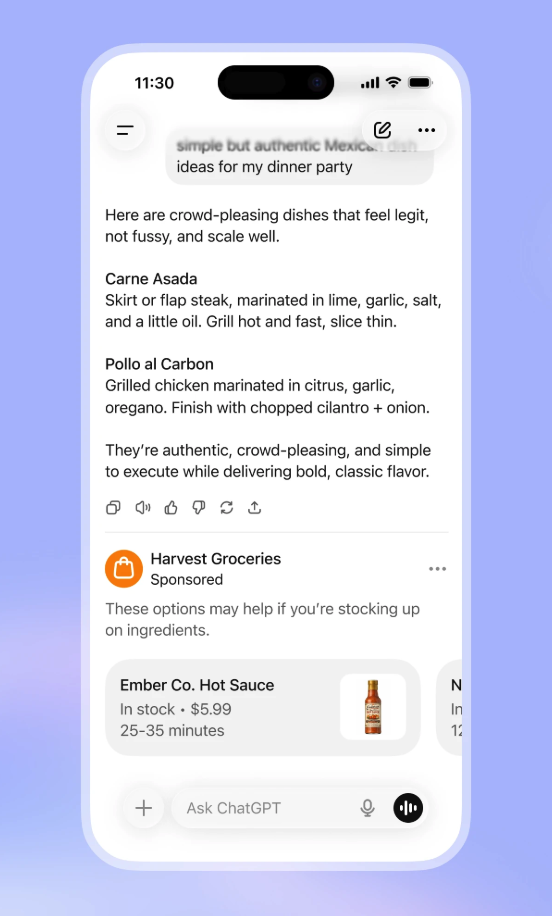
Marketers are not in the habit of overpaying for media, though sometimes it is worth it, especially if it is an innovation that may win them accolades for being first to market.
But within a short while, the reality of "performance-media-thinking" kicks in. Logic tells you that the more you pay to reach a particular audience, the more conversions you need and the more product you need to sell to make the investment worthwhile. They will be hoping that these ChatGPT ads have exceptional conversion rates — far more than other successful performance channels like search, social and programmatic.
Commentators have baulked at the price and that was my natural reaction too.
Until I got thinking: what if lowest common denominator pricing in digital media has been one of the worst things to happen to innovation online?
Inventory Pricing: The Race to the Bottom
When internet publishing was in its early days in the mid to late 90s, digital advertising started to replace print ads. The revenue from base CPMs helped cover the cost of the tech and talent, allowing publishers to build free solutions for readers. General ads could attract a $20 to $25 CPM, and premium categories like sport or business could easily go above $50 CPM.
But in the 2000s, large scale networks like Google Display Network and early versions of Programmatic came along. With access to billions of impressions from mobile and desktop exchanges globally, many supplied by publishers, the rates for display ads cratered.
The sales pitch was "why pay $50 CPM to reach a business audience on a news website, when you can profile them with Programmatic and pay $10 to reach them on a blog."
Programmatic evolved alongside social media advertising, which was cheap too. Depending on the audience you might pay $4 to $7 CPM, with amazing interest-based targeting built in for free. Display ads became a commodity, sold at low rates by the large platforms. News sites that wanted to sell ads at their earlier rates earned a new moniker — they became "Premium Environments."
Standalone sites couldn't band together to counter the prevailing market forces (except through mergers or acquisitions). Their funds were under pressure. The money used to truly innovate went to the larger platforms — and boy have they used it. Those properties that could afford a premium, like video-based entertainment sites with mass appeal, fought like hell to value their media as effectively as possible.
So What Has This Got to Do with OpenAI?
They have a desirable product and a controlled market in a product they have developed. They're essentially saying, "we are not going out with bargain basement rates. We know we have an exclusive product and we're going to charge accordingly."
We can speculate on the confidence. Perhaps they have faith in their product. Perhaps users of ChatGPT have higher intent and will convert at a higher rate. Perhaps there's a premium to be expected for the low ad load and positioning. Or perhaps they need to show high value to their investors.
Rather than take the "start-low-and-increase-pricing-as-we-scale" strategy, they are placing a premium on the early-adopter market they control and they are hoping marketers will do the same.
Will the Strategy Work?
Many marketers work on a "media-first basis" — they'll win accolades for getting into AI and more specifically, getting close to OpenAI.
But over time, performance-thinking comes down to simple lines on a spreadsheet. And ChatGPT ads will have a major starting price disadvantage.
What's the alternative though? Start low and go lower? We've seen where that leads.
The pricing strategy signals confidence. It's a statement of intent. It may work out for them, and as long as it shows the value of an audience and doesn't follow the race to the bottom that's plagued digital media for two decades, I'm inclined to respect the gamble.