As a lifelong sci-fi geek, I've spent years wondering when humanoid robots would finally start walking among us on city streets. This week I got a jolt: a Reddit post suggests that day might be closer than I thought.
Credit for the discovery goes to Reddit user u/dopehead9, who posted to r/whatisit under the title "What are these contraptions these guys were carrying?" The photos, reproduced here with credit to the original poster, show two of three men u/dopehead9 says they spotted around Seaport in Boston, each wearing a heavy black backpack bristling with fans, batteries and cables that snake up to a head-mounted rig with a camera and a tracking arm. One of them is also holding what looks like a handheld gimbal on a long pole. u/dopehead9's first instinct was that they were mapping something, but they weren't sure enough to say more than that.
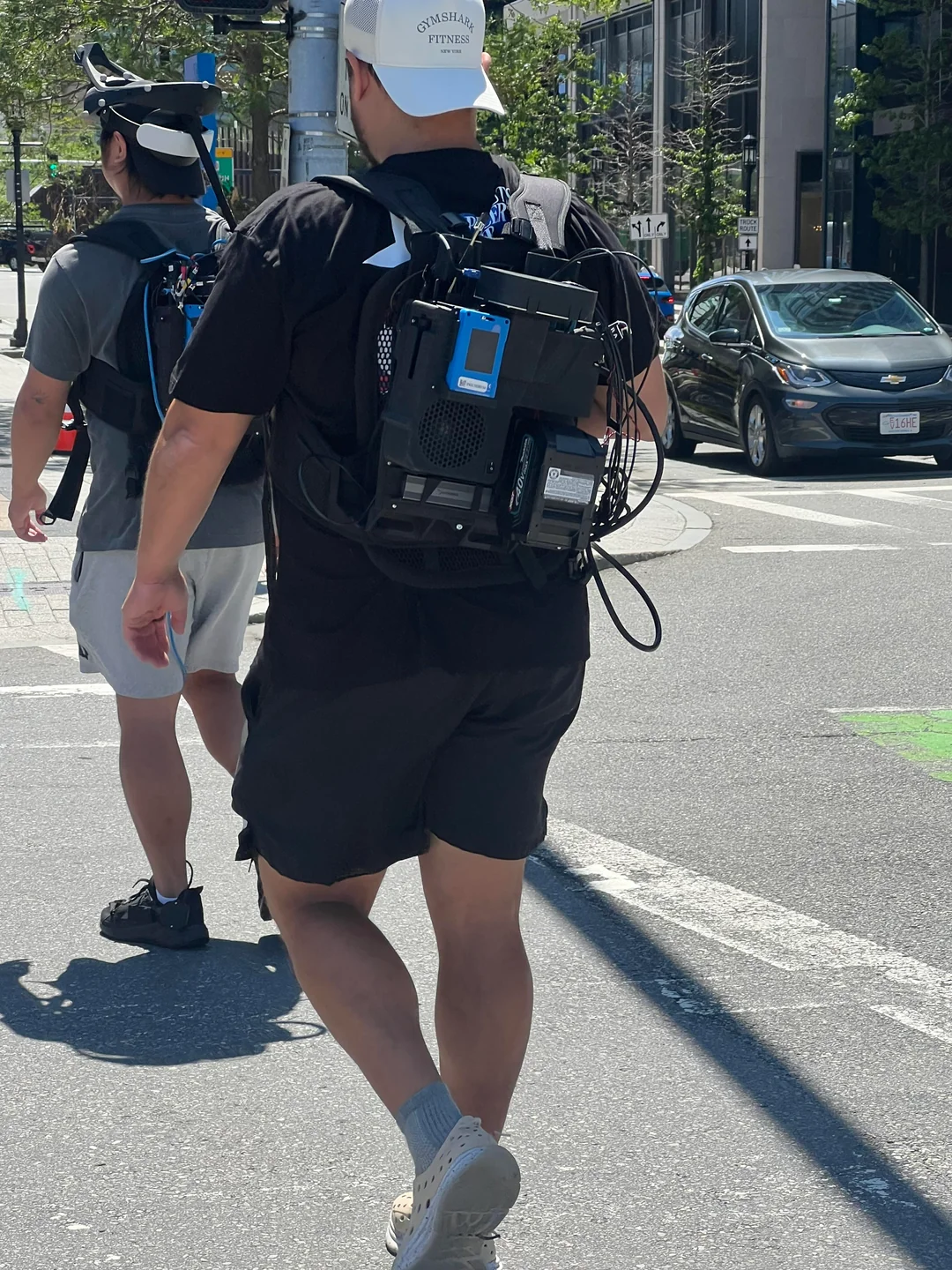
Naturally, the internet had theories. The top-voted explanation, and the one the post got tagged "Solved" for, was refreshingly mundane: this is drive-test or walk-test equipment, used to measure cell signal strength as someone physically walks a route, so telecom engineers know where a new tower or a repositioned antenna is needed. Several commenters said they'd done exactly this job, one describing it as an "insane rate of pay" for a fairly niche gig that gets filled by word of mouth rather than job ads.
But a second theory kept gaining traction underneath it, and it's the one that actually stopped me scrolling. A commenter who said they used to work at Google looked closer at the head-mounted unit and concluded it wasn't a signal reader at all, but a GNSS and camera rig, paired with a lidar-and-motion-capture backpack, built to log exactly how a person moves and sees while walking a pedestrian route. Their read: this is AI training data collection, quite possibly for a robot being taught to navigate sidewalks. Another commenter backed this up from personal experience, saying a robotics company had recorded them wearing similar gear while they did their actual warehouse job of carrying and packing boxes.
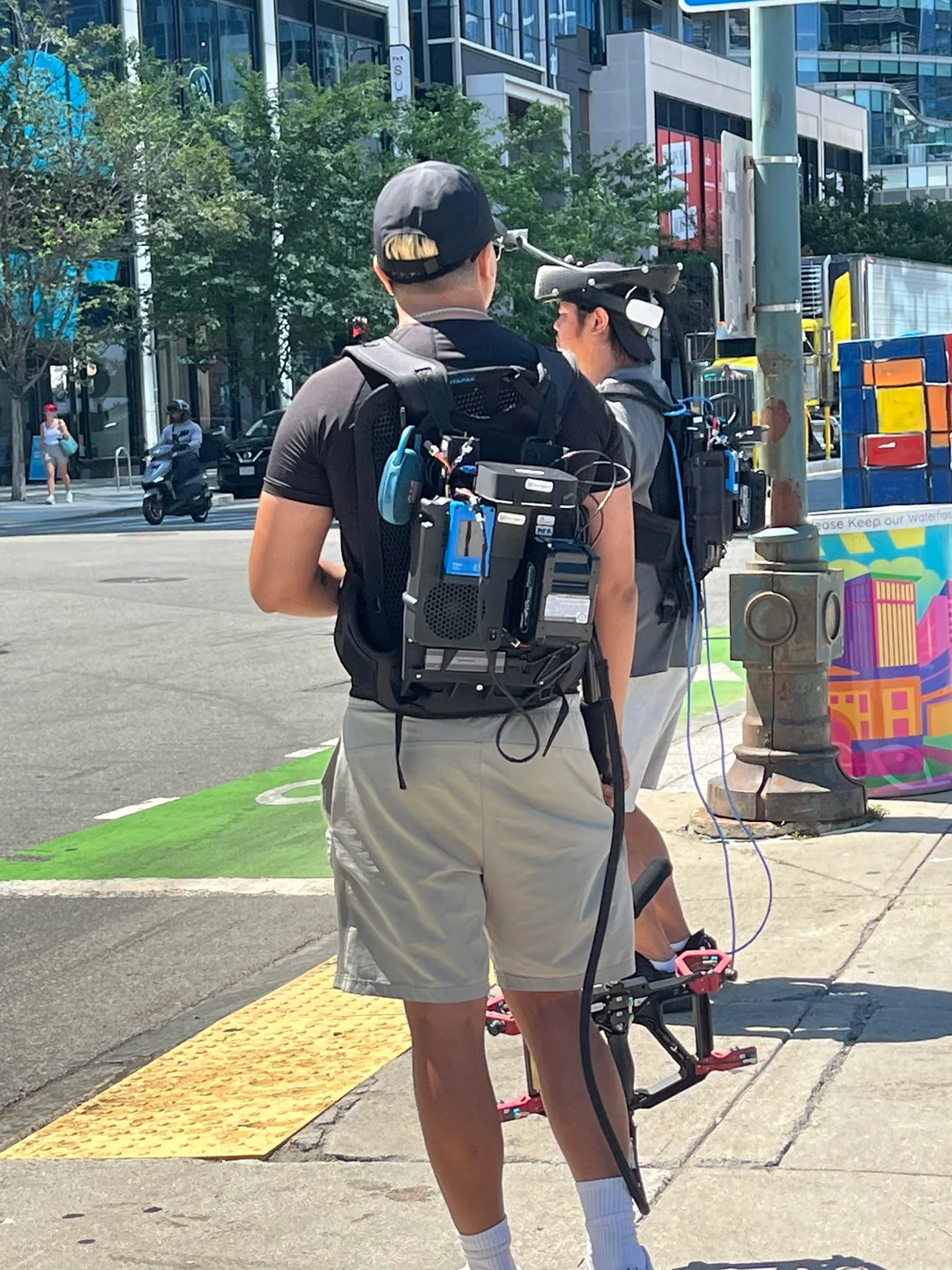
So which is it? Realistically, the drive-test explanation is the more likely one on its own merits — it's a well-documented, decades-old job, and the gear matches known walk-test kits closely enough. But once I found out where the photo was actually taken, the robot theory stopped looking like a stretch. Seaport is not a random patch of Boston to be carrying that kind of gear around.
People Really Are Wearing Suits to Teach Robots to Move
Boston Dynamics used exactly this approach to train its Atlas humanoid. In a segment with 60 Minutes, correspondent Bill Whitaker wore an Xsens motion-capture suit while performing a task, and that recorded human movement was fed into Boston Dynamics' machine learning pipeline, where more than 4,000 digital versions of Atlas then practiced the movement in simulation, with variables like slippery floors and stiff joints thrown in to build robustness.
Researchers in China have built a similar system using a lighter exoskeleton suit that tracks the wearer's joints and body height with wrist sensors and a back-mounted lidar scanner. Feeding that data into a Unitree G1 humanoid took its success rate on a pick-and-place task from 5 percent to nearly 80 percent. And it's not limited to labs: delivery companies have outfitted warehouse staff with movement-tracking sensors partly to study workplace injuries, and partly, by their own admission, to build training data for robots that could eventually take over the same tasks. There's now a small, well-paid gig economy built around exactly this kind of work, with specialist companies contracting people to wear capture rigs and perform tasks repeatedly so robots can learn from the footage.
Separately, there's a growing body of academic research specifically focused on getting robots to handle open, unpredictable pedestrian environments — sidewalks, crossings, other people — rather than the controlled floor of a warehouse or factory. Benchmarks with names like SidewalkBench and datasets built around pedestrian-robot interaction exist precisely because legged and wheeled robots are being tested for exactly the kind of city-street navigation the second Reddit theory describes.
Why Seaport Specifically Matters
Boston's Seaport district is home to MassRobotics, the world's largest independent robotics innovation hub, based at 12 Channel Street with additional space at 88 Seaport Blvd. It's a working incubator, not a museum: dozens of robotics startups run out of it at any given time, using its labs and testing space to build and trial hardware, and its accelerator has graduated companies working on exactly the kind of navigation and perception systems that would need real-world pedestrian footage to train on. Three guys walking around Seaport in matching sensor rigs are, geographically, about as close to a robotics company's front door as you can get in Boston.
Zoom out and the wider region backs this up too. Boston Dynamics, headquartered in Waltham just outside the city, announced a $100 million expansion into a 323,000-square-foot facility this year, expecting to add 1,250 jobs by 2033, with the state chipping in a $25 million incentive to keep the investment local. The area is also home to the Robotics and AI Institute, MIT, Draper Laboratory and Toyota Research Institute, and companies like Locus Robotics, Realtime Robotics and Pickle Robot have all grown out of the same talent pool. Just this month, Cambridge-based Walden Robotics, spun out of Toyota Research Institute and built on work from MIT's Russ Tedrake, raised $300 million at a $1.1 billion valuation to build AI-powered robots for factory and warehouse work, backed by Nvidia, Boeing and Toyota — one of the biggest robotics funding deals in Boston's history.
So, Are the Robots Coming?
Given where this photo was taken, I'd now put real weight on the robot theory. Humanoid and legged robots that can operate around real people in real streets are being actively trained right now, with serious money behind the effort, and Boston's Seaport sits right in the middle of the cluster doing that work. Three guys in matching mocap-and-lidar rigs walking the neighbourhood around MassRobotics looks a lot less like a coincidence and a lot more like a robotics startup logging pedestrian footage for a navigation model. The cell-tower explanation is still plausible in isolation. It's just a lot less plausible once you know the postcode.