I nearly became a walking cliché — a middle-aged guy with a bit of spare cash, about to buy a pair of turntables and a mixer and call myself a bedroom DJ.
Luckily I mentioned it to my son first. He does visuals at a drum and bass club, and he sees this exact story play out all the time. Someone buys decks, learns three transitions, and a few weeks later the whole setup is gathering dust in a cupboard. His advice was to try an instrument instead of a mixing desk — something where you're actually making the music rather than just blending other people's tracks together.
Enter the Pineapple Donkey
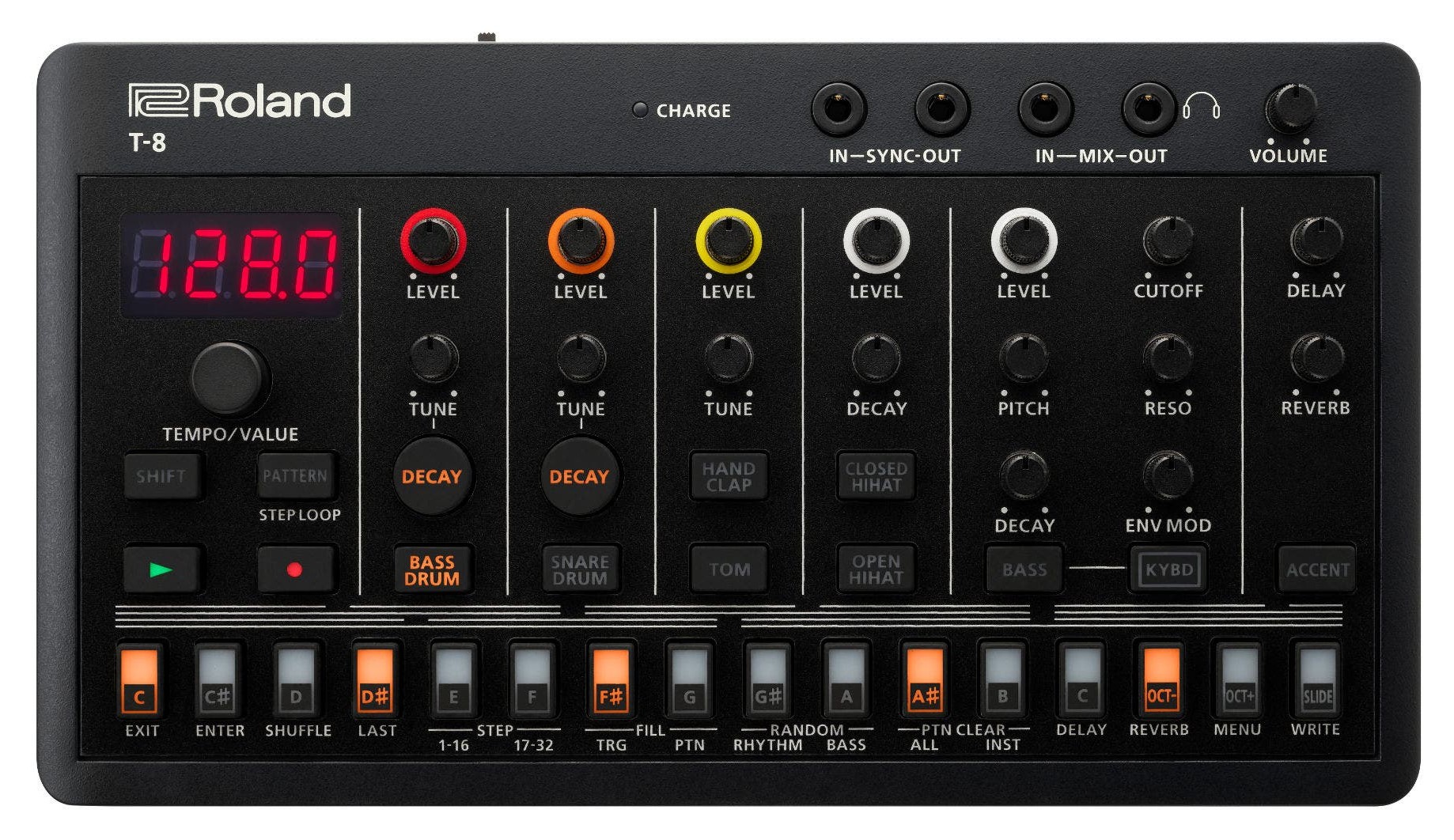
Around the same time, an Instagram reel landed in my feed of 𝗔𝘁𝘀𝘂𝗼 𝘁𝗵𝗲 𝗣𝗶𝗻𝗲𝗮𝗽𝗽𝗹𝗲 𝗗𝗼𝗻𝗸𝗲𝘆 cooking up filthy acid house on a tiny box called the Roland T-8. That was all it took — a couple of days later I wandered into the Rock Shop on K' Road in Auckland and bought one.
The T-8 is part of Roland's Aira Compact range, and it's tiny — light, with an inbuilt USB-powered battery, and small enough to fit in a jacket pocket. Don't let the size fool you though. Inside it are faithful recreations of some of the most famous drum machines and synths in dance music history: the 808, the 909 and the 606, plus a bass synth modelled on the squelchy, wobbly TB-303 that basically invented acid house in the first place.
Six drum tracks, one bass track, USB audio and MIDI, and a pile of built-in effects — pretty much all of 90s and 2000's club music distilled into something the size of a paperback.
Claude Taught Me the Theory
Here's the bit I didn't expect. I know nothing about musical notation, and even less about how a house beat is actually built, so I asked Claude to teach me from scratch — what a bar is, what a step is, why house music sits at 120-something BPM, and what order you actually build a beat in. It put together a proper training PDF for me: the basics of notation, the anatomy of a house beat, how the different drum elements sit together. My own cheat sheet, made in minutes.
AI is genuinely brilliant for this kind of thing — no judgement, no pace pressure, just a patient explanation of exactly what you don't know yet.
Then YouTube Took Over
Armed with the theory, I went looking for hands-on lessons, and @musicalfuturesofficial on YouTube became my teacher. His step-by-step walkthrough builds a version of Benny Benassi's "Satisfaction" from scratch on the T-8 — bass first, then toms, then hi-hats, then the full bass track laid down on top. Following along and actually building the track myself, watching the pieces click into place one at a time, was ridiculously satisfying.
So Much Fun
Here's me having a go, bass track and all.
This one isn't going in a cupboard — it sits on my desk and it gets used. Turns out what I actually wanted all along was to make my own tracks, badly at first, on a machine built to recreate the exact sounds that soundtracked the club scene thirty years ago. My son was right about the instrument over the mixer.