Apple's Worldwide Developers Conference on Monday was a significant event by any measure — iOS 27, iPadOS 27, macOS 27, a rebuilt Siri, new image generation, an overhaul of Safari, performance improvements across the board. The volume of announcements makes it easy to lose the thread. Three things stood out to me as worth understanding in more depth.
The Parental Controls Are Genuinely Good
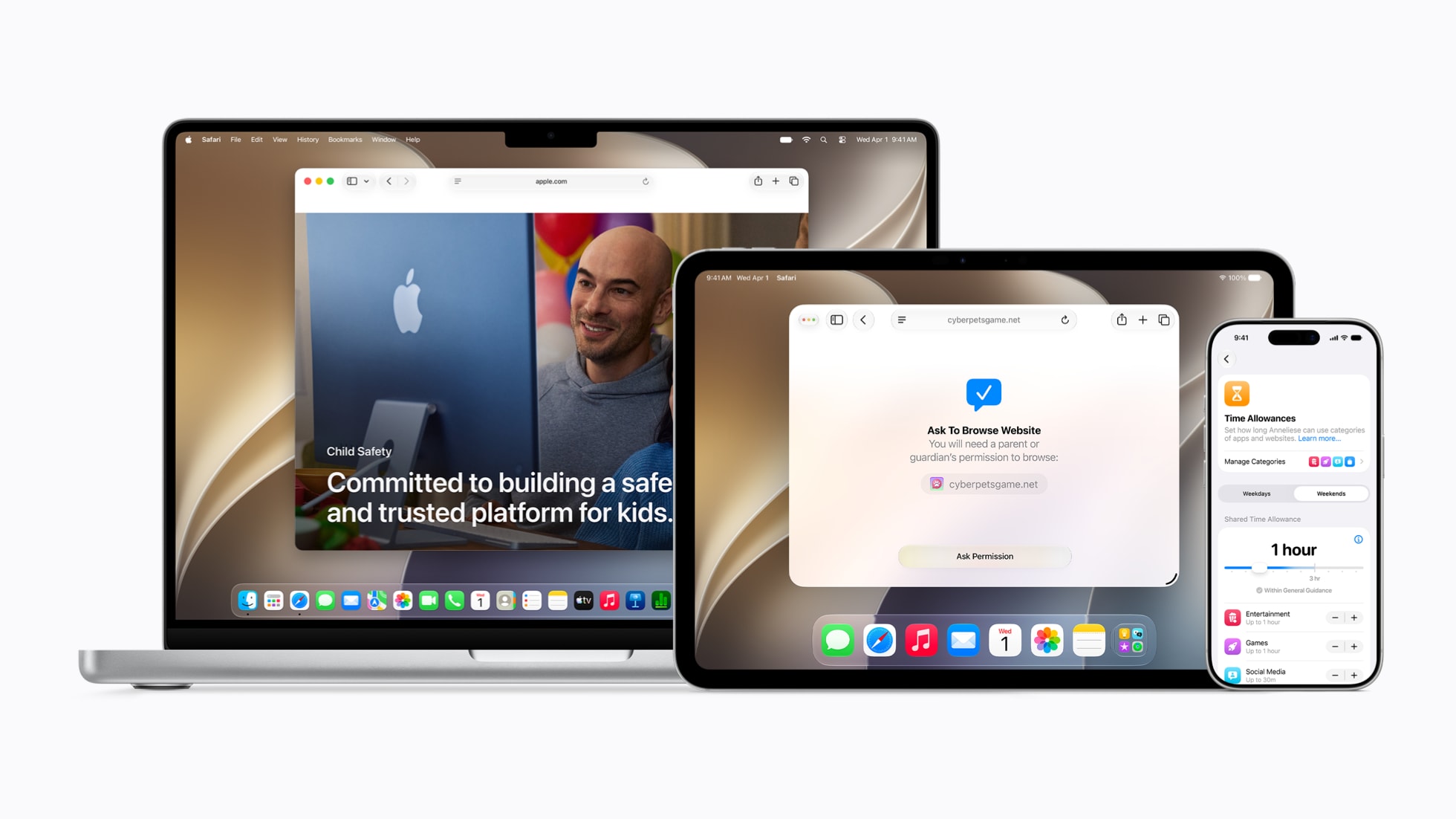
Apple has been doing parental controls for years, but what it announced at WWDC 26 is a more considered and complete approach than anything it has shipped before. The centrepiece is a redesigned Screen Time paired with a proper child account framework — and the thinking behind it shows signs of real consultation with people who understand how children actually use devices.
Setting up a child account now immediately enables age-appropriate protections across the system: age-gated content in the App Store, adult website restrictions, and defaults tuned to the child's age. Parents choose exactly which apps their child can access from the outset, with the ability to add more over time. The new Ask to Browse feature extends the existing Ask to Buy model into Safari, so children need parental approval before visiting a new website — not just before downloading a new app. For parents who have worried about what their kids are stumbling across on the web, that is a meaningful addition.
Time Allowances let parents set daily limits by category — Entertainment, Games, Social Media — and Apple has sensibly included default recommendations from child development research as a starting point rather than leaving parents to guess at reasonable numbers. Schedules add another layer, letting parents determine which apps are accessible at different times of day, so focused periods like school or dinner are not a constant negotiation.
The redesigned Screen Time dashboard gives parents an at-a-glance view of how their child is actually spending time, and making adjustments — extending access, restricting a category, locking things down for a family dinner — is now quick enough to do in the moment rather than requiring a visit to Settings. Apple has also been working with the American Academy of Pediatrics to adapt its Family Media Plan as a resource for parents using these tools. That kind of institutional backing gives the guidance more credibility than a generic Apple recommendation.
None of this solves the deeper questions about children and screens that researchers are still working through. But as a set of tools for parents who want to be deliberate about their children's digital lives, it is a substantial step forward.
Siri Is Finally the Assistant It Should Have Been
The most practically significant AI announcement from WWDC 26 is the complete rebuild of Siri. Apple is calling it Siri AI, and the gap between what it can do and what the old Siri could do is substantial enough that the shared name feels like a formality.
The old Siri's most persistent limitation was that it existed largely outside your life. It could set a timer or tell you the weather, but it could not search your emails, read your messages, or look through your photos in any meaningful way. Siri AI changes all of that. You can ask it to find the hotel confirmation buried in a three-month-old email, or surface the restaurant a friend recommended in a message last week, or pull up photos from a specific trip. It draws on personal context across the apps you actually use — including third-party apps when developers integrate with Spotlight.
Beyond personal context, Siri AI can go out to the web for answers on topics it does not know locally, and carry on a real back-and-forth conversation rather than treating each question as a separate event. There is a dedicated Siri app that syncs conversational history across your devices via iCloud, so you can start something on your Mac and continue it on your iPhone. Visual Intelligence — the ability to point your camera at something and ask questions about it — extends to iPad and Mac for the first time. And Writing Tools are now integrated everywhere you type, with Siri capable of drafting from scratch or mirroring your usual tone when writing to a specific person.
The caveats are real. Siri AI launches as a beta later this year, in English only, and due to the EU's Digital Markets Act it will not be available on iOS or iPadOS in the European Union at launch — a significant omission for a large part of Apple's customer base. EU users will get it on macOS, watchOS, and visionOS, but not on the platforms where most people actually interact with Siri. Apple's statement on this was unusually blunt: regulators, it said, would not engage constructively on any of its proposed solutions, and there is currently no timeline for EU availability on iPhone or iPad.
Still, the underlying shift is genuine. Apple has spent years building a reputation for having the weakest assistant of the major platforms. This is a serious attempt to change that.
Google Is in the Small Print
Apple's press release on the new Apple Intelligence architecture runs to several thousand words. The most remarkable sentence in the entire document appears near the end, tucked quietly into a paragraph about privacy: the next generation of Apple Foundation Models were "custom-built in collaboration with Google and its Gemini models."
Read that again. The AI brain now running inside your iPhone was built with Google.
This is not a minor footnote. Google currently pays Apple somewhere in the region of $20 billion a year to remain the default search engine in Safari — a deal that has attracted antitrust scrutiny in multiple jurisdictions. The two companies have always had a complicated relationship: genuine partners in infrastructure, genuine rivals in product. But this goes further. Apple has now co-developed the foundational models that power its most important new software features with the same company it competes against for the attention of every person who owns an iPhone.
Apple is at pains to emphasise that the privacy architecture remains entirely its own — Private Cloud Compute, on-device processing, the promise that personal data is never stored or accessible to Apple or anyone else, with the ability for independent experts to verify that claim at any time. The privacy layer is Apple's. But the intelligence underneath it was built with Google's help.
What this means for the long-term relationship between the two companies is an open question. What it tells us right now is that Apple looked at the task of building frontier AI models entirely in-house and decided a partnership was the pragmatic choice. Given the resources Google has poured into Gemini, that is probably the right call. It is still a significant thing to acknowledge — and the fact that it was buried rather than celebrated says something about how Apple wants that story to be read.